A 10-week live online course
The Architecture
of 64
Exploring the ancient foundations of Human Design & the Gene Keys through the I Ching.
with Fabrice Boulenger
Starts 11/11/26
10 live sessions · 90 minutes each · Taught in English
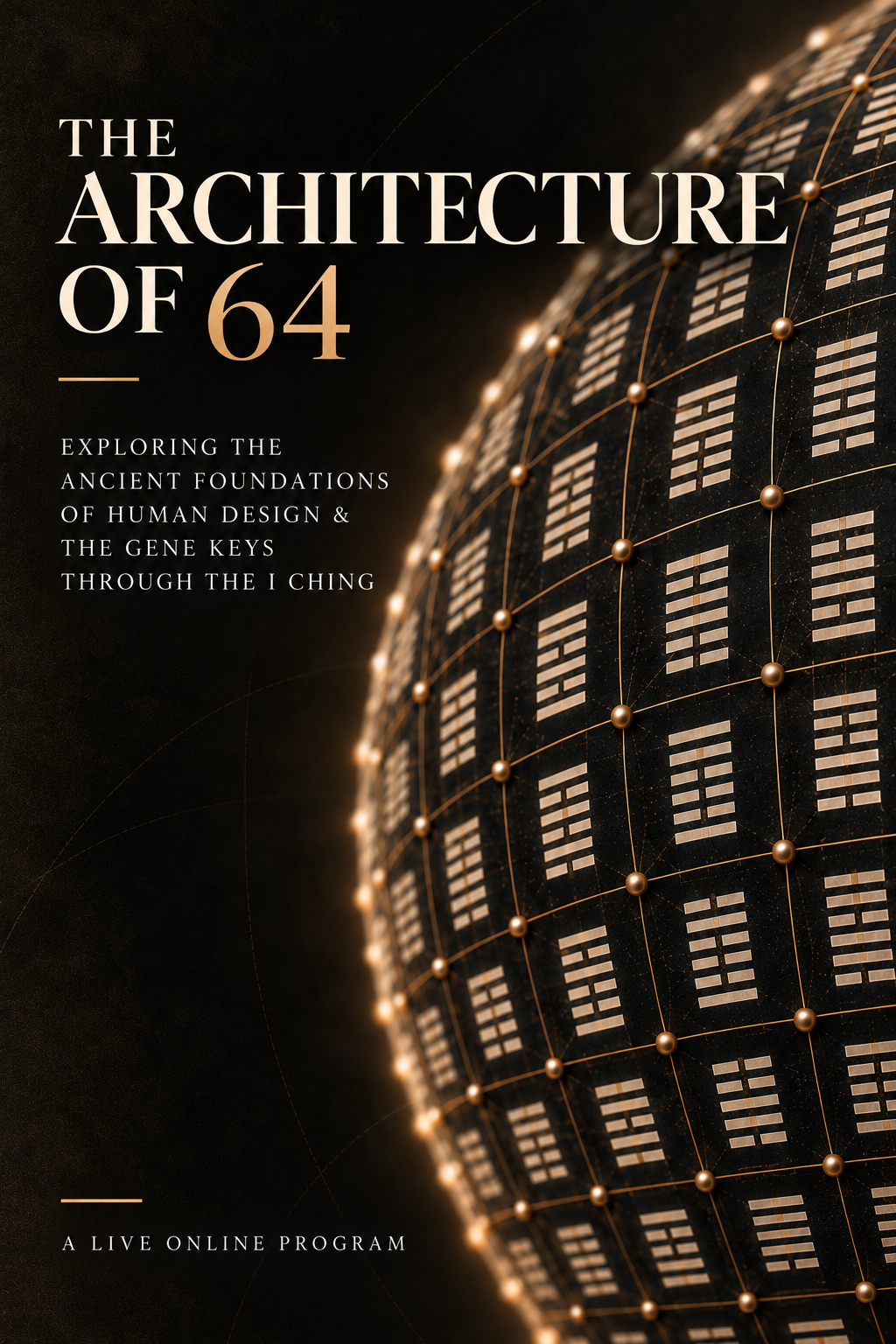
A 10-week live online course
Exploring the ancient foundations of Human Design & the Gene Keys through the I Ching.
with Fabrice Boulenger
Starts 11/11/26
10 live sessions · 90 minutes each · Taught in English
Why study this?
The eight trigrams are the building blocks of the 64 hexagrams behind Human Design and the Gene Keys.
The course begins with what each trigram represents and how two of them combine to form a hexagram. Each week, we’ll study one trigram family, compare its eight Gene Keys and look at where its Gates sit in the Human Design chart.
Then we’ll work with examples from your own profile. If you’re contemplating Gene Key 29’s Gift of Commitment, for instance, we’ll explore its doubled Water trigram and compare it with the seven other hexagrams that also have Water in their lower half. We’ll use that to ask specific questions about how you enter experiences, what you commit to and what it means to follow through.
Course structure
An opening session on how yin and yang generate the four bigrams, eight trigrams and 64 hexagrams. We’ll introduce the main maps we’ll use, and place the I Ching alongside the later Human Design and Gene Keys interpretations. We’ll also ask why 64 recurs in genetics and Indian traditions, and what those comparisons can tell us.
One session is devoted to each trigram family. We begin with the trigram and its doubled hexagram, then follow the eight variations formed when it meets each upper trigram.
We’ll compare the classical images, Gene Keys spectra and Human Design placements, then apply those perspectives to the Gates or Gene Keys you’re contemplating. There will be time to discuss the connections that feel useful and question those that don’t.
We’ll bring the different maps together and return to the questions they open about change, individuality and the whole. A final opportunity to integrate the material and explore how you want to continue working with it.
The eight trigram sessions are listed by theme; their teaching order will be confirmed.
Across the ten sessions
Path to Core: follow nuclear reduction to explore the recurring structures beneath a hexagram.
Path to Source: contemplate the release of distinctions back toward undifferentiated potential.
Path of Recognition: keep each form intact while recognising it as part of the whole.
Drawing on Kashmir Shaivism, we’ll explore the difference between withdrawing from experience and recognising unity within it. These are contemplative comparisons between traditions.
90 minutes each, with room for questions and shared contemplation.
Revisit the sessions in your own time.
Use the interactive app during and between sessions to follow trigram families, compare hexagrams and explore their geometric relationships visually.
A written companion to support your study and contemplation.
A shared space for participants to ask questions, exchange insights and stay connected between sessions.
For the curious
Gene Key 18 moves through Judgment, Integrity and Perfection. Its hexagram places Mountain above Wind/Wood: stillness or stopping meets a force associated with penetration.
One contemplation we’ll explore is how this combination relates to the sensitivity that notices what needs correction.
We’ll also learn a technique called nuclear reduction, which uses a hexagram’s inner lines to form another hexagram. Applying it to 18 and repeating the process gives:
18 → 54 → 63 ⇄ 64
The final pair alternates between After Completion and Before Completion. What might this add to our understanding of Perfection, if completion itself keeps opening into further change?
The line relationships are exact. Their significance for your own experience is something we’ll contemplate together.

Your guide
I’m Fabrice. After years of teaching Human Design and the Gene Keys, my curiosity took me deeper into the I Ching. This course is an invitation to explore what I’ve been discovering, and see what emerges when we contemplate it together.
More about Fabrice ↗Gathering online
US mornings / European afternoons. Exact time to be confirmed.
We’ll take a break over Christmas and New Year. The full session calendar will be confirmed.
Choose the payment option that works for you. Both include the full course and all materials.
Payment is handled securely by Stripe.
All sales are final. No refunds.
A question before joining? Get in touch.